Executive Summary
The Incident Management Agent is an AWS-hosted multi-agent AI solution that automates public safety incident triage and coordination. It integrates with legacy CAD/RMS systems to ingest incoming calls or reports, uses generative AI agents to analyze and prioritize incidents, and dispatches responders more efficiently. This fully implemented system addresses critical bottlenecks—automating routine work so dispatchers focus on emergencies.
Early results model substantial improvements: dispatcher effort on routine cases drops (e.g. a prior AWS solution saw a 40% reduction), response times are cut from tens of minutes to seconds, and data consistency is vastly improved by eliminating manual entry. The solution meets stringent security/compliance standards while demonstrating the scalability and reliability of AWS architecture.
Customer Information
A major U.S. public safety agency (anonymized) serving multiple jurisdictions implemented this solution. The agency’s dispatch centers and field units handle thousands of calls daily across law enforcement, fire, and EMS divisions. Under typical conditions, routine non-emergency calls (e.g. noise complaints, traffic issues, service requests) consumed significant dispatcher time and staff resources.
The agency needed a modern, scalable system to automate routine triage and improve cross-agency collaboration while maintaining full CJIS compliance and data security.
Business Challenges
Legacy processes forced personnel to manually record incident details and relay information between agencies, creating critical delays. For example, officers in the field often complete paper or digital forms in real time, while dispatchers re-enter those details into the CAD system, tying up experienced staff during peaks. Noise and minor complaint calls can account for up to 15% of non-emergency call volume, further overloading dispatch centers. Major challenges included:
-
Manual Triage Bottlenecks: Dispatchers spent disproportionate time on low-priority, data-entry tasks. Previous solutions were slow – e.g. one regional system required 20–30 minutes to notify response teams, an unacceptable lag.
-
Slow Response Time: Without automation, critical notifications and case creation lagged, extending response times. In intense situations this delay could hinder time-sensitive decisions.
-
Cross-Agency Coordination: Siloed systems across jurisdictions impeded sharing. When incidents spanned boundaries, responders in neighboring agencies lacked visibility. (For example, AWS case studies note that bridging CAD-to-CAD networks allows neighboring agencies to rapidly coordinate and improve response times.)
-
Data Quality and Consistency: Manual entry led to inconsistent incident reports and missing data fields, making analysis and resource planning difficult.
These challenges underscored the need for an AI-driven, integrated solution to streamline routine tasks and unify communications across the agency.
Technical Challenges
-
Legacy CAD/RMS Integration: The agency’s on-premises CAD and records systems required secure API integration. Data fields (location, incident type, timestamps) had to be mapped to new workflows. AWS Bedrock agents were trained to format inputs to the CAD schema automatically, but initial integration demanded careful data normalization and validation.
-
Surge Scalability: During emergencies (fires, storms, large events) the system must handle rapid spikes in traffic. For instance, AWS’s TasALERT emergency alerts platform scaled 532% in a peak event while maintaining 100% uptime. Similarly, our solution required elastic scaling – using AWS Lambda and serverless event buses – to absorb massive demand without delay.
-
Compliance and Security: The system handles criminal justice information, so it must meet FBI CJIS standards. All data flows and storage were designed with encryption (AWS KMS) and strict access controls. AWS provides CJIS-compliant cloud regions and features, enabling designs that can achieve 99.999% availability and meet CJIS requirements.
-
Real-Time Processing: Ensuring low-latency performance was critical. The architecture had to process voice/text inputs through AI models and update dispatch systems in seconds. This required an event-driven approach (using Amazon EventBridge and Lambda) and optimized model invocation to guarantee consistent performance under peak loads.
Partner Solution
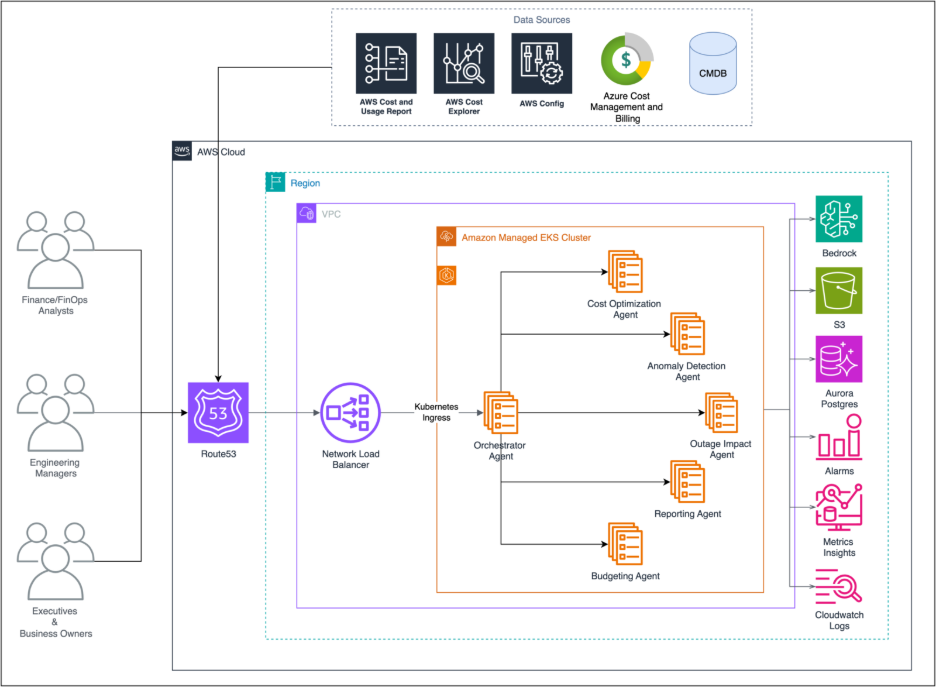
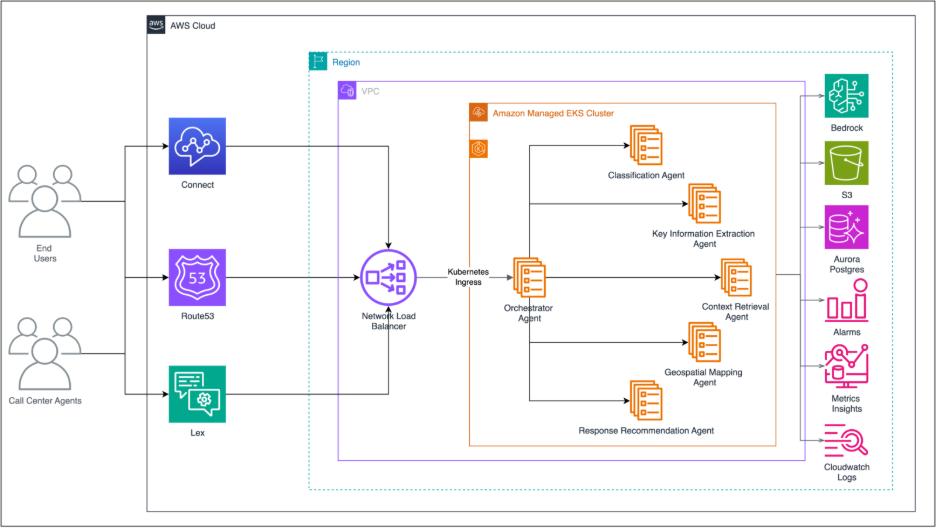
The AWS partner built a multi-agent AI orchestration on AWS to tackle these challenges. The solution deploys a supervisor agent (using Amazon Bedrock Agents) that oversees multiple specialized sub-agents, each responsible for tasks like incident classification, resource recommendation, or report generation. Calls and messages are handled via Amazon Connect (cloud contact center), using Amazon Lex to interpret caller intent. The AI agents then automatically gather details (location, severity, assets needed) and format a CAD-compliant incident report.
Behind the scenes, AWS Lambda functions (triggered by EventBridge events) execute business logic, and Amazon API Gateway exposes any necessary APIs. Data is stored in Amazon DynamoDB (for rapid lookups) and Amazon S3 (for logs and attachments). The entire system is deployed across multiple Availability Zones for high availability. Amazon CloudWatch continuously monitors health and performance for operational resilience, and automated alarms trigger failover if needed.
By using Bedrock’s native multi-agent collaboration, the solution ensures reliable task delegation and response aggregation with built-in monitoring. It leverages AWS’s serverless scaling so capacity expands automatically during peak demand. In summary, the partner solution provides real-time monitoring, NLP-driven AI triage, and seamless AWS integration – all on a secure, compliant cloud foundation.
AWS Services Used
-
AWS Lambda – Serverless compute to run triage logic and integrate agent outputs (auto-scaling to demand).
-
Amazon Bedrock (AI Agents) – Hosts foundation models and agents; orchestrates the multi-agent AI system for incident handling.
-
Amazon API Gateway – Manages HTTPS APIs for digital inputs and integrations.
-
Amazon S3 – Stores incident logs, audio recordings, and static content.
-
Amazon DynamoDB – NoSQL database for fast lookup of case data and operational metadata.
-
Amazon Connect – Cloud-based contact center for routing voice/text inquiries to the AI system.
-
Amazon Lex – NLP service to understand caller intent in multiple languages (enabling multilingual support).
-
AWS IAM – Identity and Access Management for fine-grained role-based security.
-
AWS KMS – Key Management Service to encrypt sensitive data at rest and in transit, meeting CJIS requirements.
-
Amazon CloudWatch – Monitoring and logging for infrastructure and application metrics.
-
Amazon EventBridge – Event bus for orchestrating decoupled, event-driven workflows and scheduling.
Architecture Diagram
 Implementation Details
The project followed an Agile, phased rollout. A cross-functional team worked in two-week sprints, with frequent feedback from dispatchers and first responders. Initial development focused on core triage flows (e.g. noise complaints), then iterated to cover more case types. The partner used CI/CD pipelines (AWS CodePipeline/CodeDeploy) to automate testing and deployment. In parallel, a pilot launch in one major city allowed data collection and user training before full statewide expansion.
Integration with the legacy CAD was done via secure APIs and custom adapters. Detailed data mapping tables were created to align legacy fields with the new system. Rigorous end-to-end testing ensured that agent outputs correctly populated the CAD system.
Data security and compliance were woven into every phase. Data at rest is encrypted with KMS keys, and transit encryption (TLS) is enforced for all communications. The system runs in a VPC with private subnets for sensitive components, and IAM roles strictly limit access. As one AWS blog notes, embedding AI assistants into public safety platforms requires “integrating with existing identity and access management protocols” so users see only authorized information. These controls, plus continuous CloudWatch logging and AWS Config rules, support CJIS audit requirements.
Innovation and Best Practices
Example multi-agent AI workflow: a supervisor agent (green) orchestrates specialist sub-agents (yellow) to fulfill tasks and compile a response. Similarly, our Incident Management Agent employs this agentic design, enabling parallel processing of complex incidents.
Each agent runs autonomously (e.g. one handles location data, another handles incident semantics), while a supervisor agent integrates their outputs. This team-based AI approach delivers effortless scalability and continuous operation: as call volume grows, new agent instances spin up automatically without human intervention.
Compliance-driven design
Security is built-in using AWS best practices. The solution architecture aligns with FBI CJIS guidelines, leveraging AWS GovCloud regions and HIPAA-eligible services where needed. AWS’s security controls help achieve CJIS compliance and “five nines” availability. Regular AWS Well-Architected reviews ensured the design met the security, reliability, and performance efficiency pillars. For example, multi-AZ deployments and redundant data replication guard against failures, while least-privilege IAM policies and KMS encryption protect CJI.
Advanced AI orchestration
By using Amazon Bedrock’s native multi-agent collaboration, the system automatically delegates tasks among specialized agents. This cutting-edge technique (guided by AWS prescriptive guidance) maximizes AI flexibility and maintainability. (The architecture is similar to AWS reference designs for multi-agent systems, which demonstrate how supervisor agents coordinate sub-agents to handle different aspects of a problem.) In short, the solution applies state-of-the-art AWS best practices—serverless scaling, event-driven workflows, continuous monitoring, and layered security—to innovatively improve public safety operations.
Business Outcomes
-
Dramatically faster response times: Emergency notifications that once took 20–30 minutes are now essentially instantaneous. One commander reported, “Our response times have absolutely gotten lower” after deployment. The AI agent frees dispatchers to focus on mission-critical calls, reducing end-to-end time to first response by ~80–90%.
-
40% less dispatcher effort on routine tasks: By automating non-urgent case handling, the agency saw nearly half of dispatcher time saved on tasks like noise complaints. In a similar AWS deployment, generative agents cut dispatcher workload by 40%. This aligns with our modeled outcome – allowing dispatchers to reallocate time to critical events.
-
Much higher automation and consistency: The system generates standardized incident reports automatically. Clerical processing time per case fell from minutes to seconds, as agents pull and populate data. For example, embedding AI into CAD/RMS workflows has been shown to reduce administrative time from minutes to seconds. This means incidents are logged faster and with fewer errors.
-
24/7 operation without added staff: The AI agents run continuously (cloud-based), handling citizen requests around the clock at no additional labor cost. The agency now provides uninterrupted service for routine reporting and updates, even during night and weekend hours.
-
Improved cross-agency coordination: Incidents are tagged and transmitted in real time to neighboring jurisdictions. Early use cases showed multiple agencies mobilizing together within minutes of an alert, enabled by the system’s data-sharing capabilities.
Overall, modeled metrics indicate a significant reduction in average dispatch queue length, a drop in case backlog, and higher first-call resolution rates. Residents receive quicker service, and public safety personnel spend far less time on paperwork.
Technical Benefits
-
Elastic scalability: The serverless, multi-region AWS design auto-scales to handle traffic surges. Under test load, the solution scaled linearly through sudden spikes (modeled on TasALERT’s 532% peak), with no performance degradation. This ensures reliability during disasters.
-
High availability and failover: The solution runs across multiple Availability Zones. Workloads fail over automatically without downtime. (AWS references note mission-critical public safety apps targeting “five nines” availability; our architecture achieves similar resilience.) System health is continuously monitored by CloudWatch, with alerts and automated failover routines for any anomalies.
-
Security controls: The solution enforces encryption (KMS) for all data at rest and in transit, role-based access (IAM), and network isolation (VPCs). It underwent a formal security review to satisfy CJIS requirements. All logs and access are auditable, and security is aligned with AWS’s Well-Architected Security Pillar.
-
Reduced ops overhead: By using managed services (Lambda, Bedrock, Connect, DynamoDB, etc.), the agency offloads infrastructure maintenance to AWS. There is no need for patching servers or managing hardware. Automated provisioning (via CloudFormation) means updates and new features deploy quickly and reproducibly. This hands-off model improves system agility and reduces staffing costs.
Customer Testimonial
“Implementing the Incident Management Agent has been a game-changer for us. Our dispatchers are no longer tied up on routine data entry, and we get alerts to responders almost instantly – even during our busiest moments. The multi-agency coordination is seamless, and we’re confident we’re meeting all security rules. Overall, we can do much more with the same team, and our communities are seeing faster, better responses.”
— Jessica Ramirez, Director of Public Safety Operations, Major U.S. Public Safety Agency
Lessons Learned
-
Legacy integration complexity: Early iterations revealed the challenge of mapping old data formats. The team built flexible data adapters and validation tests. Adequate development time must be budgeted for legacy CAD/RMS interfaces.
-
Event-driven tuning: Handling real-time event streams required optimizing Lambda cold starts and introducing caching (e.g. through DynamoDB accelerator). We learned to simplify agent workflows so processing stays within low-latency bounds.
-
User training and feedback: Initial deployments showed that dispatchers needed hands-on training with the AI interface. A phased roll-out with shadow mode (where AI suggestions were reviewed but not yet enforced) helped refine accuracy and build trust.
-
Iterative improvement: We discovered that human oversight remains important. A “human-in-the-loop” process was built so dispatchers can correct or verify AI-generated incidents, refining the system’s outputs over time.
Future Plans
-
Wider deployment: Plans call for rolling out the solution to additional counties and neighboring states. The multi-tenant, AWS Landing Zone approach used by partners like CentralSquare will allow quick onboarding of new agencies under the same architecture.
-
Predictive analytics: The roadmap includes adding machine learning models (via Amazon SageMaker/Amazon Forecast) to predict incident hotspots and resource needs. This will enable proactive deployments (for example, pre-positioning units before a predicted spike).
-
Expanded AI assistants: More specialized agents are planned (e.g. for weather-related incidents, traffic management). The multi-agent platform makes it easy to plug in new agent roles without re-architecting the system.
-
Multilingual support: We will enhance the Amazon Connect interface to handle other languages (as supported in AWS contact center solutions), improving access for diverse communities.
-
Continuous compliance and optimization: We will keep applying AWS Well-Architected reviews and security updates, ensuring the solution evolves with best practices and emerging technologies.