A single day of invoice delay can lock millions in working capital — across a $1 B enterprise, that’s ≈ $27 M in frozen liquidity.
Every delayed invoice hurt visibility, vendor trust, and cash velocity. Akira AI reimagines finance with autonomous agents that reason, decide, and act—turning manual operations into intelligent systems of action.
Executive Summary
Finance teams still waste thousands of hours validating invoices, reconciling payments, and responding to supplier queries.
Manual validation and fragmented communication erode productivity, increase compliance risk, and obscure liquidity.
The Agentic Finance Stack — Akira AI + ElixirData + Nexastack AI — eliminates these frictions through autonomous, data-driven workflows where autonomy, analytics, and assurance operate as one.
|
Fabric |
Platform |
|
Akira AI — Agent Fabric |
Multi-agent orchestration across ERP, mail, and analytics for real-time action. |
|
ElixirData — Data Fabric |
NLP & Document AI for structured extraction + forecasting intelligence. |
|
Nexastack AI — Governance Fabric |
Continuous compliance, explainability, and audit readiness for every automated decision. |
Result: An intelligent Finance ecosystem that operates 24 × 7, learns continuously, and remains audit-ready.
Why Now
-
Liquidity pressure: Every 24 h of delay ties up 2–3 % of working capital.
-
AI governance maturity: Agentic models can now reason across ERP, mail, and analytics with built-in controls.
-
Regulatory shift: DPDP Act, GDPR, and SOX updates demand explainable automation and continuous auditability.
AI governance maturity, cash volatility, and regulatory demand have converged — making autonomy a finance necessity.
The Agentic Finance Story: Operations → Analytics → Governance
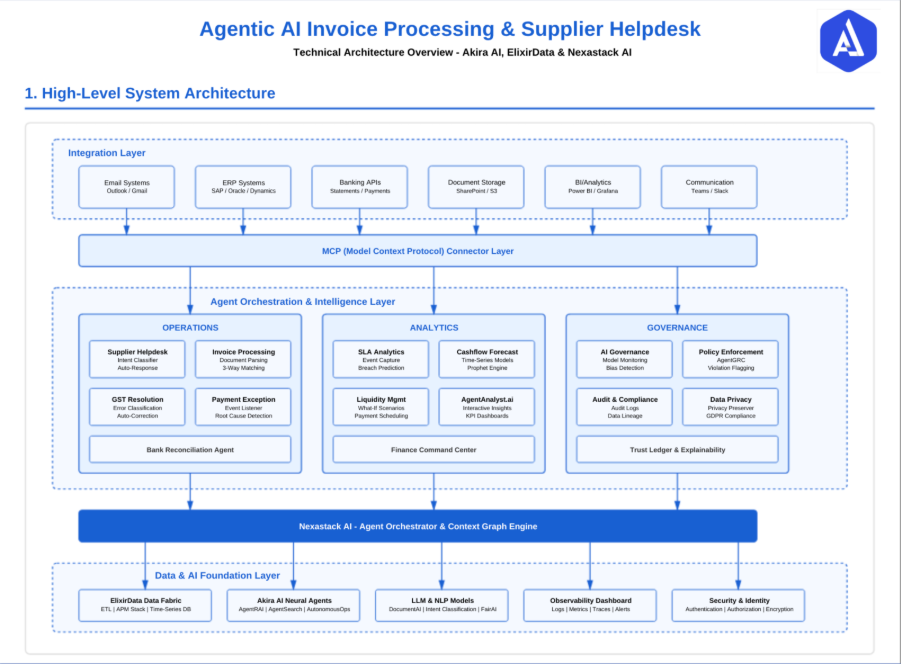
Figure 1: High-level architecture connecting Operations, Analytics, and Governance layers through the MCP integration fabric across Akira AI, ElixirData, and Nexastack AI
Autonomous Operations
The operations layer powers continuous financial workflows through interconnected agents that communicate, validate, and resolve — without human intervention.
Supplier Helpdesk Automation
-
Connection Agent links Outlook / Gmail mailboxes via secure MCP server.
-
Intent Classifier (ElixirData LLM) detects query type — status, resubmission, invoice not found, or escalation.
-
ERP Retrieval Agent fetches invoice or payment details through Nexastack MCP Connect.
-
Response Composer crafts context-aware replies with PO number, invoice status, and payment ETA.
-
Escalation Agent routes unresolved cases to approvers and logs closure automatically.
Business Value: Delivers 24 × 7 supplier visibility and reduces manual triage by nearly 70 %, freeing finance teams for strategic work.
Invoice Processing (PO & Non-PO)
-
Vendors send invoices (PDF / Excel) to a shared mailbox.
-
Document Parser (ElixirData Document AI) extracts structured fields like PO, GRN, and GSTN.
-
Validation Agent cross-checks vendor code, PO number, and GRN references.
-
Matching Agent performs a three-way match for PO invoices.
-
Workflow Agent routes non-PO invoices for approval via the Akira Orchestrator.
-
ERP Entry Agent posts validated transactions automatically and triggers confirmation emails.
-
Errors and exceptions appear in the Observability Dashboard for audit visibility.
Business Value: Cuts invoice cycle time from 3 days to under 4 hours and improves posting accuracy across ERP systems.
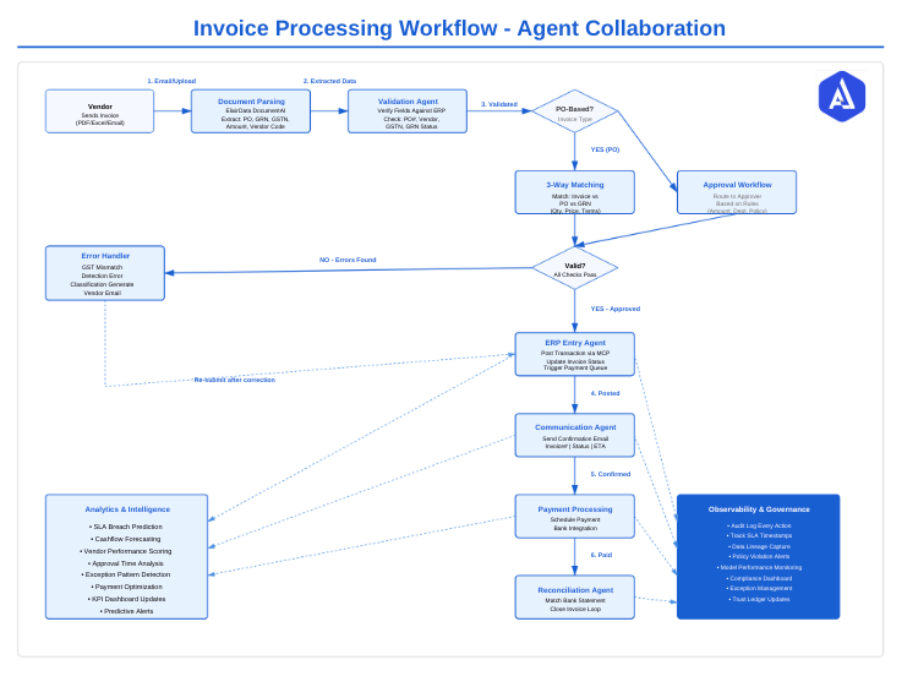
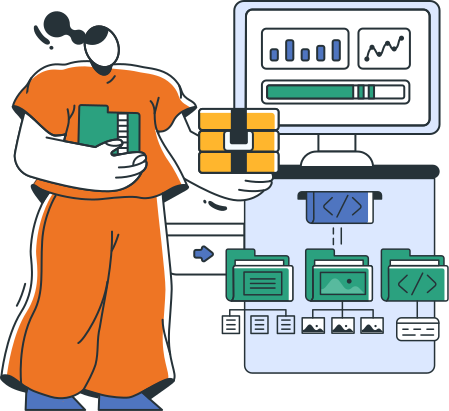
Figure 2 - Illustrates collaboration among Parsing, Validation, Matching, and ERP Entry Agents for seamless invoice flow and auto-posting.
Invoice Resolution & GST Mismatch Handling
-
Continuous Audit Agent (Nexastack) monitors ERP for rejected or mismatched GST entries.
-
Error Classifier detects issues such as invalid GST IDs or tax differences.
-
Vendor Comms Agent automatically drafts discrepancy emails with contextual data.
-
Revalidation Agent reprocesses corrected invoices and closes the loop.
Business Value: Accelerates resolution cycles from days to hours, ensuring 100 % GST compliance and zero missed recoveries.
Payment Exception Handling
-
Event Listener Agent tracks ERP payment-queue events.
-
Root-Cause Detector identifies failures (bank reject, budget limit, timeout).
-
Recovery Agent retries or escalates automatically.
-
Vendors notified via helpdesk integration; exceptions logged for visibility.
Business Value: Transforms reactive troubleshooting into predictive stability in the payment pipeline.
Bank & Settlement Reconciliation
-
Reconciliation Agent ingests daily bank feeds (API / CSV).
-
Matches credits and debits with ERP invoices and payments.
-
Flags unmatched entries with probable reasons (timing or reference mismatch).
-
Finance Controller Dashboard (Agent Analyst) visualizes reconciliation rates, pending items, and exceptions.
Business Value: Delivers 2× faster reconciliation cycles with a unified, audit-ready ledger.
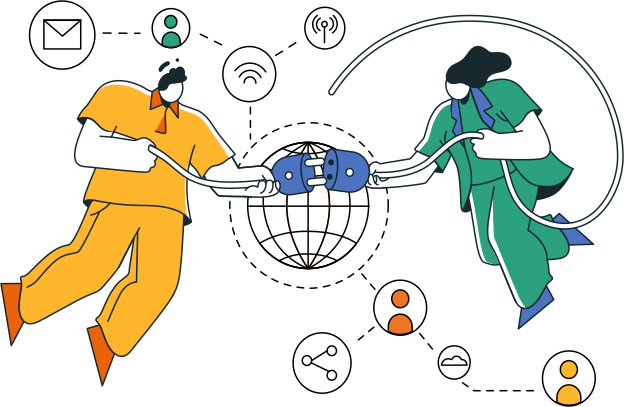
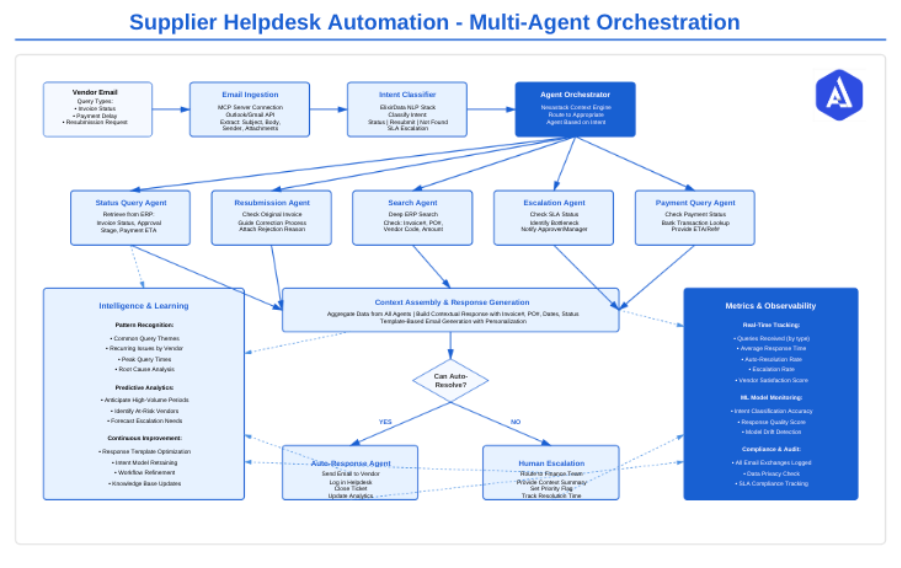 Figure 3 – Supplier Helpdesk Automation: Multi-Agent Orchestration
Predictive Analytics & Foresight
Analytics transforms automation into foresight. The integration of Akira AI, ElixirData, and Nexastack AI converts event telemetry into actionable predictions.
Invoice SLA Analytics & Reporting
-
Event Capture Agent timestamps each invoice stage (Received, Approved, Paid).
-
Data stored in Elixir Data's APM Stack with vendor, department, and region metadata.
-
SLA Monitor Agent calculates turnaround and breach rates.
-
Predictive Delay Agent (Nexastack Forecast Engine) identifies likely SLA risks.
-
Dashboards in Grafana / Power BI highlight delay trends.
Business Value: Enables controllers to pre-empt SLA breaches, improving compliance to >95 %.
Cashflow Forecasting & Predictive Payment Scheduling
-
Forecast Agent analyses historical payment data and approval cycles.
-
Uses ElixirData’s Prophet-based models to predict 30/60/90-day outflows.
-
Liquidity Agent simulates “what-if” scenarios such as PO delays or budget shifts.
-
Dashboards visualize predicted cash-flow and liquidity gaps.
Business Value: Gives CFOs proactive visibility to plan disbursements and sustain optimal liquidity.
Finance Command Center
-
Context Graph Engine (Nexastack) aggregates all operational and analytical signals.
-
Agent Analyst provides unified dashboards showing:
-
Top vendors by invoice volume and SLA breach
-
Average approval times per department
-
Payment delay root causes
-
Forecasted cashflow by region
Business Value: Transforms raw data into real-time financial intelligence for agile decision-making.
Governance & Trust — Responsible Autonomy by Design
Autonomous systems require embedded guardrails. Nexastack AI’s Governance Fabric ensures every automated action is explainable, compliant, and audit ready.
AI Governance Dashboard
-
Governance Agent tracks model performance and data usage.
-
FairAI Module (ElixirData) monitors fairness, bias, and drift.
-
Audit Fabric (Nexastack) logs all ERP actions and AI decisions.
Key Compliance Benefits
-
Continuous SOX / ISO 27001 alignment
-
End-to-end data lineage visibility
-
Model explainability dashboards
-
40 % faster audit readiness cycles
Policy Enforcement & Exception Auditing
-
Agent GRC enforces approval thresholds and spend rules.
-
Policy Violation Agent flags out-of-policy transactions and routes alerts.
-
Trust Ledger captures all exceptions for compliance review.
Business Value: Creates continuous compliance rather than periodic, manual enforcement.
Data Privacy & Responsible AI
-
Privacy Preserver Agent anonymizes vendor data before LLM use.
-
Agent Evaluation Suite (Nexastack) continuously assesses accuracy, bias, and performance drift.
-
Results feed back into retraining cycles for Responsible AI assurance.
Business Value: Builds trust and ensures full data governance and ethical AI alignment.
Technology Stack Snapshot
|
Platform |
Layer |
Core Functionality |
|
Akira AI |
Agent Fabric |
Multi-agent orchestration for Helpdesk, Invoice Processing, Reconciliation, Forecasting |
|
ElixirData |
Data Fabric |
NLP, DocumentAI, APM Stack, Time-Series Forecasting |
|
Nexastack AI |
Governance Fabric |
Audit Fabric, Policy Engine, Trust Ledger, Agent Evaluation |
Business Value and ROI
|
Capability |
Before |
After (Agentic AI) |
|
Invoice Validation |
2–3 days |
< 4 hours |
|
Supplier Queries |
Manual |
Autonomous 24×7 |
|
Payment Exceptions |
Reactive |
Predictive & Self-Healing |
|
Reconciliation |
Spreadsheet |
Automated Dashboard |
|
SLA Compliance |
≈ 70 % |
> 95 % |
|
Audit Readiness |
Manual |
Continuous & Explainable |
Financial ROI Example: For a $1 B enterprise handling 100 K invoices per year, Akira AI reduces cost per invoice by ≈ 40 %, releasing $20–30 M in working capital annually.
Adoption Journey: Deploy in < 6 weeks via API integration (SAP/Oracle) — no ERP rewrite required.
|
Role |
Key Outcome |
Value Metric |
|
CFO |
Working-capital visibility & liquidity optimization |
$20–30 M liquidity released annually |
|
Controller |
Continuous compliance & real-time SLA oversight |
95 % SLA adherence, 40 % faster audit cycles |
|
Accounts Payable Head |
Cycle-time reduction & error-free posting |
3 days → 4 hours per invoice |
|
CTO / CDO |
Seamless integration & scalable governance |
Deployed in 6 weeks via API; ERP-agnostic architecture |
Competitive Advantage
Akira’s agents' reason and act contextually across finance systems—delivering 2× faster cycle times and higher accuracy than legacy tools.
Enterprises can start with a single module (e.g., Supplier Helpdesk) and scale across invoice management, reconciliation, and forecasting via the Agent Fabric.
Outcome — From Process to Performance
Finance transforms from a process executor to an autonomous steward of enterprise capital.
-
Akira AI orchestrates tasks and communications.
-
ElixirData enriches insights and forecasts.
-
Nexastack AI ensures trust and explainability.
Together they create a closed loop of Autonomy · Analytics · Assurance, delivering a finance function that is predictive, governed, and continuously audit-ready.
Frequently Asked Questions (FAQs)
Get quick answers about Agentic Analytics, AI agents, and how ElixirData powers autonomous enterprise intelligence.
What is Agentic Analytics?
Agentic Analytics uses autonomous AI agents to automate data collection, analysis, and insight generation — enabling intelligent, context-aware decision-making.
How is it different from traditional BI tools?
Traditional BI visualizes data, while Agentic Analytics interprets and acts on it autonomously, using real-time AI agents.
What AI technologies power Agentic Analytics?
Core technologies include large language models (LLMs), vector databases, knowledge graphs, and reinforcement learning.
What role does semantic modeling play?
Semantic modeling allows AI to understand data relationships and context, improving accuracy and insight relevance.
What industries benefit most from Agentic Analytics?
Industries like finance, healthcare, retail, and manufacturing leverage Agentic Analytics for automation, prediction, and data-driven optimization.