Modern enterprises generate and store vast amounts of data across databases, SaaS platforms, data lakes, warehouses, and document systems. Yet despite this abundance, teams often struggle to answer fundamental questions: What data do we have? Where did it come from? Can we trust it? And is it safe to use?
This is where Data & Schema Discovery becomes foundational.
As data ecosystems grow more complex and dynamic, traditional manual catalogs and static documentation can no longer keep pace. Enterprises now require automated, intelligent systems that continuously discover, classify, enrich, and govern both data and schema—at scale.
Understanding Data & Schema Discovery
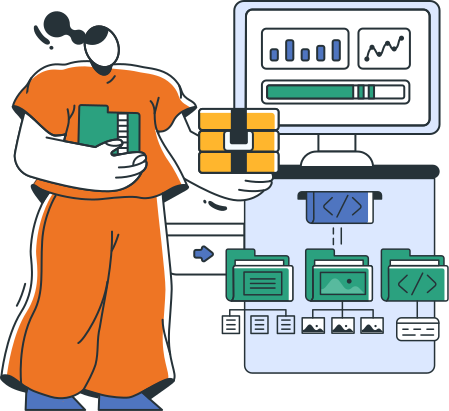
Data & Schema Discovery refers to the automated process of identifying enterprise data assets and their structural definitions—tables, fields, relationships, and schemas—across all connected systems.
Unlike basic metadata collection, modern discovery systems go further by:
-
Continuously scanning environments for new data and schema changes
-
Extracting structural and semantic metadata automatically
-
Classifying sensitive and business-critical fields
-
Enriching metadata with lineage, quality signals, and governance context
The result is not just a catalog, but a living intelligence layer that reflects the current state of the enterprise data estate.
Why Metadata and Schema Matter More Than Ever
Metadata and schema are the connective tissue of data-driven organizations. Without them, teams are forced to rely on tribal knowledge, outdated documentation, or manual validation—slowing analytics and increasing risk.
As organizations adopt AI, advanced analytics, and real-time decision systems, the importance of trusted metadata increases significantly. AI systems are only as reliable as the data and schema context they consume.
“In modern enterprises, data value is no longer constrained by storage or compute—it is constrained by trust, context, and discoverability.”
The Shift from Static Catalogs to Agentic Discovery
Traditional data catalogs rely heavily on manual ingestion, tagging, and maintenance. These approaches struggle in environments where schemas evolve frequently, and new data sources are introduced continuously.
Agentic Data & Schema Discovery introduces a new model:
-
Autonomous agents connect to enterprise systems
-
AI-driven discovery extracts metadata and schema continuously
-
Classification models detect sensitivity and business relevance
-
Enrichment engines add lineage, quality indicators, and usage context
This approach ensures that metadata remains current, accurate, and actionable, without requiring constant human intervention.
Why is metadata important for data trust?
Metadata provides context, lineage, and quality signals that help teams understand and rely on data.
Core Capabilities of Data & Schema Discovery Agents
Autonomous Data & Schema Discovery
Discovery agents automatically identify and index data from:
-
Relational and NoSQL databases
-
Cloud data warehouses and lakehouses
-
Data lakes and object stores
-
CRMs, SaaS platforms, and document repositories
AI-driven schema extraction maps tables, columns, data types, and relationships, while continuously monitoring for schema evolution. This ensures the catalog stays aligned with the reality of the data environment.
Intelligent Classification and Sensitivity Detection
Machine learning models analyze datasets to:
-
Detect personally identifiable information (PII)
-
Identify regulated or sensitive fields
-
Classify business-critical attributes
-
Establish semantic relationships across datasets
This automated classification reduces manual effort and improves consistency, forming the foundation for scalable governance and compliance.
Contextual Enrichment and Metadata Augmentation
Raw technical metadata is enriched with business and operational context, including:
-
Business definitions and ownership
-
End-to-end data lineage
-
Data quality indicators and confidence scores
-
Usage patterns and downstream dependencies
With this enrichment, datasets carry meaning—not just structure—enabling teams to understand how and when data should be used.
Is schema discovery automated?
Modern systems utilize AI-driven agents to continuously extract and monitor schemas without requiring manual intervention.
How Agentic Data & Schema Discovery Works
At a high level, agentic discovery follows a continuous loop:
Connect sources → Discover and classify → Enrich and map lineage → Serve governed intelligence
Once connected, agents operate continuously in the background, ensuring that discovery, governance, and access remain aligned as data environments evolve.

Organizational Impact Across Functions
Information Technology
IT teams gain a centralized, always-up-to-date view of enterprise data and schema assets. This reduces fragmentation, simplifies onboarding of new sources, and improves operational control.
Marketing
Marketing teams access curated, governed datasets—customer, engagement, and campaign data—through searchable catalogs. Automated classification ensures compliant usage without slowing campaign execution.
Product Management
Product teams explore schema metadata to validate data availability, reuse existing assets, and design data-driven features with confidence—reducing dependency on engineering guesswork.
Engineering
Engineers benefit from automatic schema profiling, lineage visibility, and continuous monitoring. Early detection of schema drift or anomalies helps maintain stable pipelines and integrations.
Consultants and Compliance Teams
Complete metadata, classification tags, and lineage records enable policy enforcement, audit readiness, and regulatory reporting across the data estate.
Agile and Cross-Functional Teams
Unified visibility into data and schema improves collaboration, sprint planning, and alignment—reducing delays caused by undocumented or duplicated data assets.
Sales and Revenue Teams
Sales and marketing operations access trusted, pre-classified datasets for insights, targeting, and performance analysis—while maintaining governance and compliance standards.
Enterprise Benefits of Data & Schema Discovery
Reduced Manual Effort
Automated discovery, classification, and enrichment significantly reduce manual inventory management, documentation, and tagging.
Faster Time-to-Insight
With data and schema easily discoverable and trusted, teams spend less time searching and validating, thereby accelerating analytics and decision-making.
Lower Data Preparation Overhead
Built-in quality checks, lineage, and context reduce time spent cleaning and validating data for analytics or AI workloads.
Reduced Compliance Risk
Automated detection of sensitive data and audit-ready lineage simplifies regulatory reporting and reduces exposure to compliance failures.
Why is schema discovery important for analytics?Schema discovery helps teams understand data structure, detect changes early, and prevent pipeline or reporting failures.
Why Enterprises Are Adopting Agentic Discovery Platforms
Organizations adopting agentic Data & Schema Discovery report:
-
Reduced audit and compliance effort
-
Faster onboarding of new data sources
-
Improved trust in analytics and AI outputs
-
Stronger alignment between business and technical teams
By combining automation, intelligence, and governance, agentic systems transform metadata from an afterthought into a strategic asset.
Looking Ahead: DataOps Starts with Discovery
As enterprises move toward AI-driven operations and real-time intelligence, DataOps increasingly depends on accurate, governed, and continuously updated metadata.
Data & Schema Discovery is no longer optional—it is the foundation for:
-
Reliable analytics
-
Responsible AI
-
Scalable governance
-
Confident decision-making
Organizations that invest early in intelligent discovery systems position themselves to unlock more value from their data—faster and with lower risk.
Can Data & Schema Discovery help with compliance?Yes. Automated PII detection, lineage tracking, and audit-ready metadata significantly reduce compliance risk and reporting effort.