Enterprises today are overwhelmed with data but deprived of clarity. Information exists across data warehouses, operational systems, documents, dashboards, collaboration tools, and AI models, yet decisions still rely on fragmented views and manual interpretation. The challenge is no longer data availability; it is the absence of shared, trustworthy context.
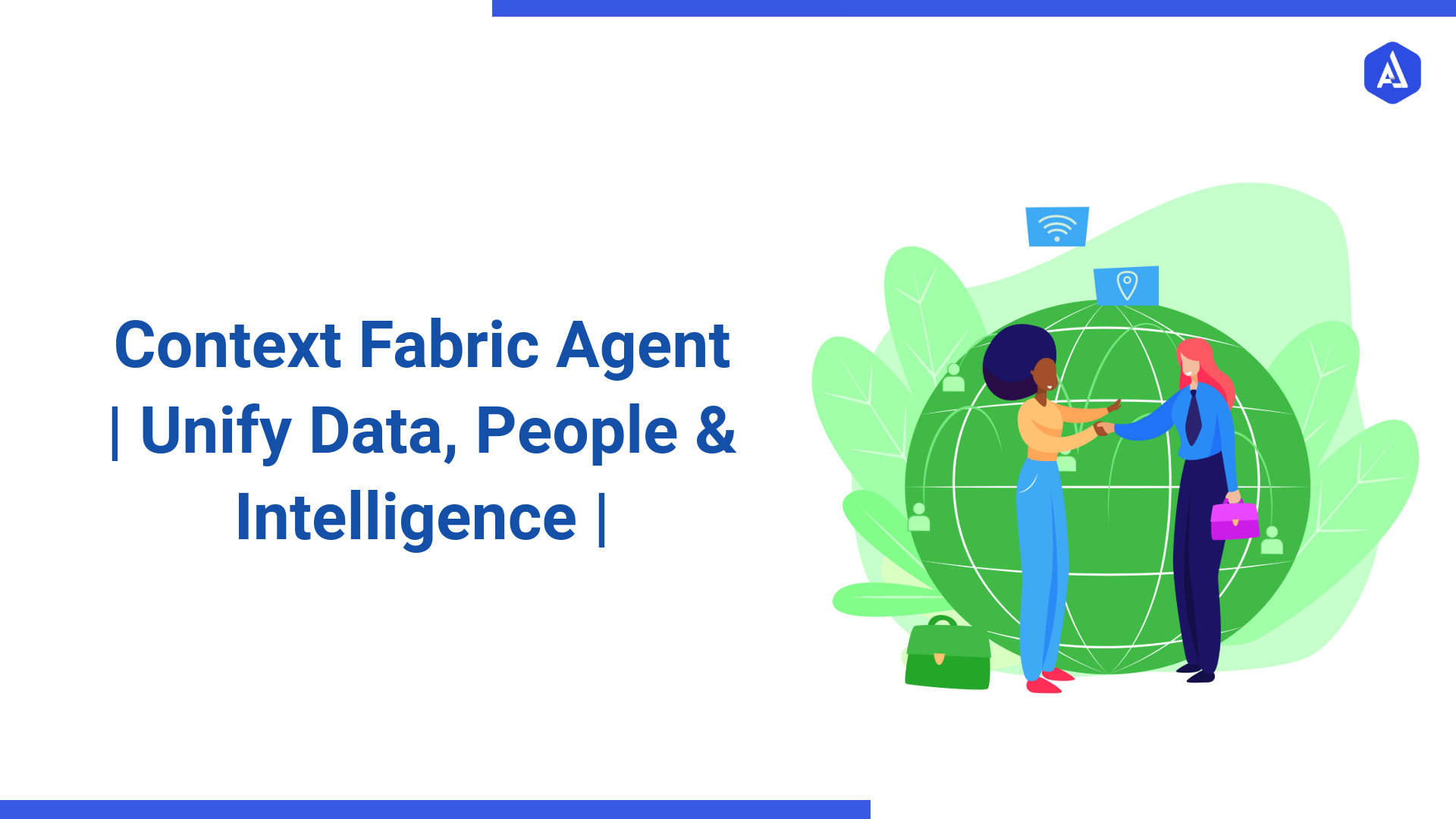
ElixirData’s Context Fabric Agent addresses this challenge by creating a unified, explainable layer of intelligence that connects enterprise data, people, and systems into a single contextual fabric. Instead of treating data, analytics, and AI as separate layers, the Context Fabric Agent weaves them together into a continuously evolving knowledge system that understands meaning, relationships, and intent.
“Context is not metadata. It is the intelligence layer that tells AI what is true, relevant, and allowed.”
By transforming fragmented information into actionable context, the Context Fabric Agent enables enterprises to make faster, smarter, and more defensible decisions at scale.
What Is a Context Fabric Agent
A Context Fabric Agent is an agentic intelligence layer that unifies structured data, unstructured information, business rules, human knowledge, and AI reasoning into a continuously updated enterprise context.
Unlike traditional integration or data management tools, a Context Fabric Agent does not simply move or replicate data. It creates semantic relationships between information, tracks lineage and intent, and ensures that every insight and automated action is explainable and governed.
At its core, the Context Fabric Agent connects four critical dimensions of enterprise intelligence:
-
Data from operational, analytical, and external sources
-
AI models and agentic workflows that consume and act on information
-
Governance, security, and compliance policies that define boundaries
-
Human context, including decisions, assumptions, and institutional knowledge
This unified fabric allows both humans and AI systems to operate with shared understanding, eliminating ambiguity and reducing the risk of incorrect or unexplainable outcomes.
What does a Context Fabric Agent do?A Context Fabric Agent unifies enterprise data, knowledge, and AI reasoning into a single contextual layer that enables explainable and intelligent decision-making.
Why Context Fabric Is Foundational for Enterprise AI
As enterprises adopt AI at scale, they encounter a fundamental limitation. AI systems are powerful at pattern recognition but lack an inherent understanding of business meaning, relevance, and constraints. Without context, AI outputs may be statistically valid yet operationally wrong, non-compliant, or impossible to explain.
The Context Fabric Agent solves this by acting as the contextual grounding layer for AI and automation. It ensures that models and agents reason over information that is accurate, current, policy-aligned, and semantically meaningful.
This capability is essential for organizations pursuing regulated AI, autonomous operations, or decision intelligence across complex environments.
Why Choose ElixirData’s Context Fabric Agent
Connected Intelligence
The Context Fabric Agent bridges AI, analytics, and governance through a unified context layer. Instead of isolated dashboards or disconnected models, enterprises gain a shared intelligence foundation where insights are derived from correlated, meaningful information.
This connected intelligence allows teams to see not just what happened, but why it happened and how it impacts downstream decisions.
Explainable Automation
Automation without explainability creates risk. The Context Fabric Agent ensures that every automated recommendation or action is transparent, traceable, and auditable.
By embedding context, lineage, and policy into every decision, enterprises can confidently scale automation while meeting internal governance and external regulatory requirements.
Secure and Scalable Framework
Built for enterprise environments, the Context Fabric Agent operates with privacy, compliance, and performance by design. It supports role-based access, policy enforcement, and secure data sharing while scaling seamlessly across teams, regions, and workloads.
How is Context Fabric different from data integration?Data integration connects systems, while Context Fabric connects meaning, relationships, and intent, enabling AI to reason and explain outcomes.
How the Context Fabric Agent Works
The Context Fabric Agent continuously ingests, correlates, and enriches information from across the enterprise. It establishes semantic relationships between data points, tracks how information is used, and makes this context available to humans and AI systems in real time. This process enables agentic context systems that adapt as the enterprise evolves.
Financial Services
In financial services, the Context Fabric Agent correlates customer profiles, transaction histories, risk signals, and compliance rules into a unified view. This enables explainable risk assessment, faster fraud detection, and more confident regulatory reporting without manual reconciliation.
Retail and E-Commerce
Retail organizations use the Context Fabric Agent to connect customer behavior, inventory, marketing performance, and supply chain data. The result is real-time contextual understanding that powers personalized experiences, optimized campaigns, and improved conversion rates.
Manufacturing and Supply Chain
In manufacturing, the Context Fabric Agent unifies production data, supplier information, and logistics intelligence. This contextual view helps identify inefficiencies, anticipate disruptions, and improve forecasting accuracy across the value chain.
Telecommunications
Telecom operators leverage the Context Fabric Agent to link network telemetry, operational metrics, and customer interactions. This enables faster root-cause analysis, reduced churn, and proactive service improvements driven by contextual insight.
Energy and Utilities
For energy and utility providers, the Context Fabric Agent connects asset data, environmental conditions, and consumption patterns. This supports predictive maintenance, operational optimization, and sustainability initiatives with explainable intelligence.
Public Sector and Government
Public sector organizations use the Context Fabric Agent to integrate departmental data and citizen information. This improves transparency, streamlines service delivery, and enables policy-aligned decision-making grounded in contextual governance.
Is Context Fabric required for explainable AI ?Yes. Explainable AI depends on contextual lineage, semantic understanding, and governance, all provided by a Context Fabric layer.
Turning Data into Meaningful Insight at Scale
The Context Fabric Agent creates a living, interconnected fabric of enterprise intelligence that evolves continuously. It enables organizations to move from static reports to dynamic, context-aware decision systems.
A unified context layer breaks down silos and ensures that every team and AI system operates with the same understanding. Smarter decisions emerge when insights are grounded in relevant, explainable context rather than isolated data points. Faster insights are achieved by reducing the time spent searching for information or resolving inconsistencies. Trusted collaboration becomes possible through lineage-aware data sharing and fine-grained access control.
Seamless Setup with Infinite Context
The Context Fabric Agent is designed for rapid deployment. Organizations can integrate it with existing data platforms, analytics tools, and AI systems without disruption. Once deployed, it immediately begins building contextual intelligence across teams and systems. This approach allows enterprises to start small and scale context progressively, aligning with evolving business priorities and AI maturity.
Key Use Cases for Connected Intelligence
Enterprise Knowledge Unification
The Context Fabric Agent creates a single connected source of truth by integrating business and operational data across analytics platforms, CRM systems, and collaboration tools. This eliminates redundant reporting and ensures consistent understanding across the organization.
Context-Aware Search and Discovery
Through contextual search capabilities such as Vera (AgentSearch), users can retrieve accurate, explainable answers instead of keyword-based results. Insights are traceable to their source, increasing confidence and reducing misinterpretation.
Business Impact Analysis
By linking actions to outcomes across finance, marketing, and supply chain operations, the Context Fabric Agent enables organizations to understand the ripple effects of decisions. This supports predictive analysis and more informed strategic planning.
AI Model Explainability
AI models powered by semantically rich context produce outputs that are more transparent and trustworthy. The Context Fabric Agent improves interpretability, reduces bias, and supports compliance with emerging AI regulations.
Unify Knowledge Simplify Intelligence Empower Teams
The Context Fabric Agent transforms enterprise information into a shared intelligence layer that humans and AI can trust. By connecting data, systems, and people through explainable context, organizations unlock faster decisions, reduced risk, and sustainable innovation.
What problems does the Context Fabric Agent solve?It eliminates data silos, improves AI explainability, accelerates insight discovery, and enforces governance across AI-driven decisions.