In today’s fast-changing business world, enterprise customer service has become critical to winning and retaining customers. Modern users expect interactions that are fast, personalized, and always available across channels. However, traditional support models struggle to scale for large-scale customer operations, often leading to delays, inconsistent experiences, and rising costs.
Customer service automation with Agentic AI is transforming this landscape. By leveraging AI agents for customer service and multi-agent orchestration, organizations can deliver real-time, personalized, and compliant support across every channel. This approach enables autonomous customer support, where tasks are routed, resolved, and escalated seamlessly—improving speed, accuracy, and customer satisfaction while giving enterprises a competitive edge.
“The future of customer service isn’t faster humans—it’s orchestrated AI agents working autonomously, securely, and at scale.”
What is Agentic AI in Customer Services?
Agentic AI customer support refers to a system of autonomous AI agents that can understand customer intent, make decisions, execute actions, and collaborate across workflows—without constant human intervention.
In enterprise customer service AI, these agents operate within governed orchestration frameworks, enabling scalable automation while maintaining security, compliance, and contextual accuracy across customer interactions.
How Do AI Agents Transform Customer Service and Support?
AI Agents
AI agents are intelligent software programs that make decisions based on inputs, context, and defined goals. Unlike rigid automation tools, AI agents for customer service can reason, adapt, and act independently. They perceive their environment, learn from past interactions, and continuously improve outcomes through feedback loops.
From handling simple queries to managing complex workflows, AI agents thrive in dynamic environments where adaptability is essential. They integrate with enterprise systems, process large data volumes, execute transactions, and evolve over time—making them ideal for enterprise customer service automation.
How does multi-agent orchestration work in customer support?
Multi-agent orchestration coordinates specialized AI agents for customer service to classify inquiries, retrieve enterprise knowledge, analyze sentiment, and escalate issues seamlessly within a governed enterprise customer service workflow.
AI Agents in Customer Service and Support
In customer support, AI agents are driving a major shift. They can classify and route inquiries, analyze sentiment, and deliver personalized responses in real time. With machine learning and natural language processing, they provide consistent, accurate, and context-aware assistance—improving response times, reducing costs, and boosting customer satisfaction.
By orchestrating multiple agents together, businesses can automate entire support workflows, ensure seamless handoffs, and deliver truly adaptive, always-on service.
AI agents classify and route inquiries, analyze sentiment, retrieve knowledge, and deliver personalized responses in real time across multiple support channels.

What Are the Biggest Challenges in Customer Service Operations?
Challenges in Customer Service and Support
Enterprise customer support teams—especially in regulated industries like banking, healthcare, and telecom—face several persistent challenges:
- Rising Inquiry Volumes: As businesses scale, customer inquiries increase rapidly, putting pressure on traditional support models.
- Consistency Across Channels: Maintaining tone, accuracy, and reliability across chat, email, voice, and digital channels is difficult at scale.
- Personalization at Scale: Delivering empathetic, personalized experiences across large-scale customer operations remains a major hurdle.
- Data Privacy and Compliance: Enterprise customer service must comply with strict regulatory standards, increasing operational complexity.
- Complex Issues: Technical or domain-specific problems require expert intervention, but routing them efficiently is often slow and manual.
How Do Agentic AI Systems Solve Customer Service Challenges?
Customer service automation with Agentic AI addresses these challenges by orchestrating intelligent agents across the support lifecycle:
- Automating repetitive and high-volume customer inquiries.
- Instantly classifying and routing issues to the right agent or expert
- Adapting tone and response style using real-time sentiment analysis
- Retrieving relevant enterprise knowledge for faster, accurate responses
Generating insights that continuously improve service quality and efficiency
Traditional customer support struggles with scale, consistency, and personalization. Agentic AI solves these challenges by orchestrating autonomous agents that automate resolution while maintaining governance, compliance, and customer empathy.
Agentic AI systems automate inquiry handling, route issues intelligently, analyze sentiment in real time, and escalate complex cases to humans with full context—reducing response time, improving consistency, and lowering support costs.
Akira AI for Agentic Customer Service and Support
Akira AI transforms customer service and support with a collaborative ecosystem of specialized AI agents. Working together, these agents automate inquiries, personalize interactions, and resolve issues faster—enabling organizations to deliver exceptional, autonomous customer service at scale.
.jpeg?width=4000&height=2250&name=image%20(1).jpeg)
Customer Service and Support Process Flow with Akira AI
-
Inquire
Customers begin through their preferred channel—email, chat, social media, or contact forms. -
Case Classification
AI agents automatically categorize inquiries by type, urgency, and priority. -
Knowledge Retrieval
Relevant information and context are instantly retrieved to craft accurate, personalized responses. -
Sentiment Monitoring
The system tracks tone, intent, and customer sentiment throughout the interaction, ensuring empathetic and adaptive communication. -
Security & Compliance
All interactions are safeguarded with encryption, access controls, and regulatory compliance measures to protect sensitive customer data. -
Complex Query Handling
If an issue requires deeper expertise, the system escalates to a human agent with full context for faster resolution. -
Performance Analysis
Metrics such as resolution time, response quality, and customer feedback are continuously analyzed to improve service and agent efficiency.- How does Akira AI integrate with existing CRM systems?
Akira AI integrates with existing CRM platforms through secure APIs and connectors, enabling enterprise customer service AI agents to access customer context, update records, and operate within large-scale customer operations.
- How does Akira AI integrate with existing CRM systems?
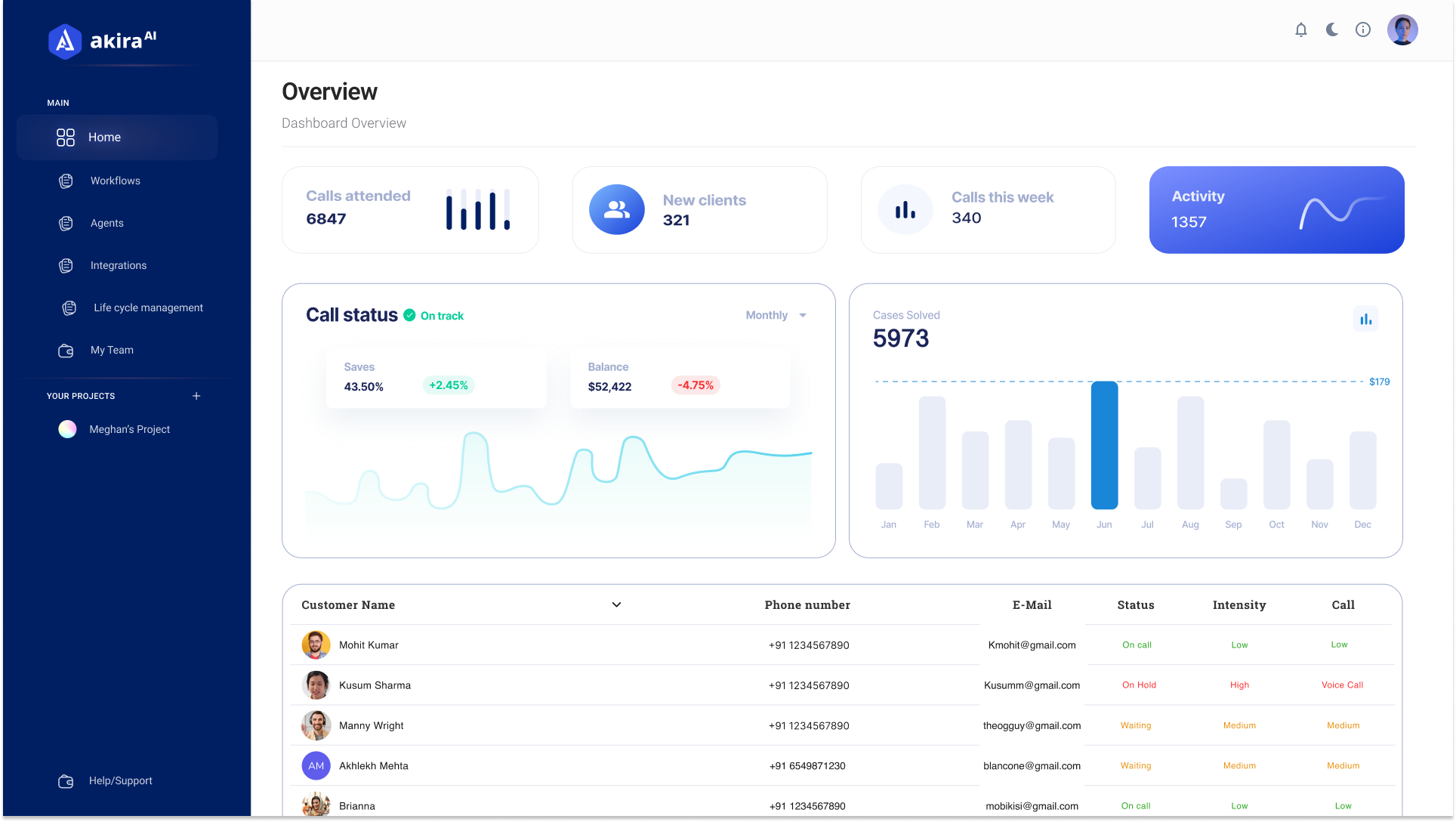 Figure: Performance Analysis of Autonomous Customer Support
Technical Stack of Agentic Customer Service and Support
Our composite AI framework utilizes the components from traditional Machine learning to advance Multi-agent systems:
|
Layer |
Component |
Stack |
|
Data Source |
Data aggregation |
ERP systems, Emails, Supplier portals |
|
Multiagent Layer |
Agents |
Advanced agent frameworks like Langchain, LangGraph, and Autogen for agent development |
|
Knowledge Graph |
Neo4j or Amazon Neptune |
|
|
RAG (Retrieval Augmented Generation) |
Langchain, Llama Index frameworks, and Knowledge Graphs utilized for building RAG pipelines and copilot agent |
|
|
Orchestration Layer |
Agent orchestrator |
Guardrails: Azure OpenAI Content Filter or custom implementation of guardrails |
|
Multi-Agent System |
AutoGen, LangGraph for complex agent interactions |
|
|
ML Layer |
NLP agents |
NLTK, spaCy for semantic analysis |
|
Data Layer |
Data Pipeline |
Industry-leading databases and data pipelines, such as PostgreSQL for structured data and Qdrant for vector data |
|
Backend |
Backend pipelines |
Built using industry best practices to develop secure and scalable APIs |
|
Frontend |
User Interface |
Developed using industry best practices to ensure a secure and user-friendly interface |
|
Infrastructure Layer |
Infrastructure |
Utilizes best-in-class infrastructure options, including on-premises, cloud-based, and hybrid solutions |
Multi-Agent System for Agentic Operations
The Akira AI multi-agent ecosystem collaborates to deliver intelligent, autonomous, and human-like customer support experiences.
1. Master Orchestrator Agent
The central controller coordinates the entire workflow. It delegates tasks to specialized agents, ensures compliance, and leverages large language models (LLMs) with knowledge graphs for accurate, rule-based decision-making.
2. Dynamic Inquiry Classification Agent
Automatically categorizes customer inquiries by type, urgency, and context using NLP and machine learning. This ensures each request is routed to the right channel quickly and accurately.
3. Adaptive Knowledge Retrieval Agent
Delivers real-time, context-aware answers by tapping into a continuously updated knowledge graph. It personalizes responses based on past interactions, improving accuracy and customer satisfaction.
4. Sentiment & Behavior Analysis Agent
Analyzes tone, sentiment, and communication patterns to adapt responses dynamically. This creates empathetic, human-like interactions that enhance the customer experience.
5. Security Agent
Ensures data privacy, compliance, and protection through encryption, access control, and monitoring. It proactively mitigates risks and upholds customer trust.
6. Co-Pilot Agent
Supports human agents with deep domain insights and recommendations during complex cases. This hybrid collaboration improves resolution quality and efficiency.
Traditional AI vs. Akira AI Solution
|
Aspect |
Traditional Customer Support |
Akira AI |
|
Efficient Autonomy |
Manual Processes: Dependence on too much human intervention makes for tardiness and inconsistency. |
High Autonomy: AI agents implement most of the activities with little intervention from human beings. |
|
Response Time |
Variable Response Times: Human agents respond according to their availability and load, many times leading to delays. |
Immediate Feedback: AI agents give immediate feedback, which vastly decreases wait times.
|
|
Consistency |
Inconsistent Quality: From agent to agent, human quality is inconsistent and relies on knowledge and accuracy. |
Uniform Responses: Standardized responses by AI agents are symbolic of consistency and uniformity. |
|
24/7 Availability |
Limited Coverage: Thorough Coverage Human agents are only available during some hours and do not cover all time zones. |
AI agents are available 24/7, which provides uninterrupted support free from any interruptions caused by time or location. |
|
Personalization |
Variable Personalization: The personalization depends on variable knowledge the agent has about the customer and past interactions. |
Advanced Personalization: AI agents use analytics to offer very personalized responses in accordance with previous customer history and preferences. |
What are the Benefits of Akira AI in Customer Service and Support?
1. Improved Productivity
AI agents automate repetitive queries, freeing human agents to focus on complex cases. This speeds up resolution and boosts overall team efficiency.
2. Enhanced Customer Experience
With real-time sentiment analysis and context-aware responses, customers receive faster, more personalized, and empathetic support—driving satisfaction and loyalty.
3. Scalable and Adaptive Support
Built on a modular, agentic architecture, Akira AI can scale effortlessly with business growth and adapt quickly to changing customer needs.
4. Consistent and Compliant Service
The Security Agent ensures every interaction meets privacy, data protection, and regulatory standards—building trust while reducing compliance risks.
5. Human-AI Collaboration
Co-Pilot Agents assist support teams with insights and recommendations, enabling smoother workflows and higher-quality outcomes through hybrid teamwork.
Next Step towards Unified Agentic Platform
In today’s fast-moving world, AI-powered multi-agent systems are reshaping customer service and support. Akira AI delivers the next generation of service excellence by combining specialized, independent AI agents into a unified ecosystem.
This agentic approach enables organizations to:
- Provide highly personalized and responsive support
- Streamline operations for greater efficiency
- Strengthen customer trust and loyalty
- Gain a sustainable competitive edge
By adopting Akira AI, enterprises unlock smarter, faster, and more scalable customer service—setting new benchmarks for performance and differentiation in an increasingly competitive market.
Conclusion
Agentic AI with intelligent orchestration is transforming customer service and support. By coordinating multiple specialized AI agents, organizations can deliver real-time, personalized, and always-on support across channels while reducing delays, inconsistencies, and operational costs.
It highlights key customer service challenges—such as rising inquiry volumes, personalization at scale, compliance, and complex issue resolution—and explains how orchestrated AI agents address them through automated classification, sentiment-aware responses, knowledge-driven resolution, and seamless human escalation.
The blog positions Akira AI as a unified, multi-agent customer service platform that combines orchestration, security, knowledge graphs, and human-AI collaboration to enable scalable, consistent, and compliant support. The result is faster resolution, improved productivity, enhanced customer experience, and a sustainable competitive advantage through autonomous yet governed customer operations.